[
Article
]

The signing of a cooperation agreement between “Jack Ma” and the Thai government created a great deal of reaction, both positive and negative. So what does Jack Ma see in Thailand?
The country was buzzing once again when our dear Uncle Tu appeared shoulder to shoulder with Thaksin Shinawatra… oops, I mean Jack Ma of Alibaba, announcing cooperation and signing an MOU with the Thai government to invest a massive sum—at the level of tens of billions—to develop Thai-Chinese e-commerce.
While signing the agreement, Jack Ma also demonstrated his flair by selling durian through Tmall.com, China’s number-one e-commerce website. The sales volume was not just impressive—it reached 80,000 durians in just one minute!!
Of course, this signing generated a great deal of reaction, both positive and negative.
On the positive side, there is the enormous purchasing power of China, with its population of over a billion. If Thai products are sold on Chinese e-commerce platforms, it is almost guaranteed that they will sell well—something like the durian sale Jack Ma demonstrated.
On the negative side, some say Jack Ma is going to dominate the entire business landscape, because this e-commerce sales channel is huge and keeps growing. As the owner of such a large e-commerce system, Jack Ma could eventually hold complete control and perhaps even determine the fate of Thai merchants and farmers.
A coin always has two sides. If there is a positive side, there is also a negative side.
But if you ask for my view on whether we should be afraid that Jack Ma will monopolize Thai e-commerce, I would say clearly: “No, I am not afraid.”
Because the truth is, hasn’t it already been dominated for a long time?
It probably started when Alibaba announced the acquisition of Lazada around two years earlier.
From that day onward, I saw Thai e-commerce players run for cover.
I do not mean they shut down and fled, but Thai e-commerce seemed merely to sustain itself rather than push aggressively to compete with Lazada as before.
From iTruemart and Weloveshopping under CP, to Central Online under the Chirathivat group, all showed clear signs of losing momentum. Not to mention Rakuten, which quietly withdrew back to Japan earlier, as if it already knew Alibaba was coming.
In business, this strategy is not wrong. We should not enter a war we already know we will lose. So if we were going to fear Jack Ma monopolizing things now, we should have been afraid two years ago.
What we should do now is learn how to live alongside Jack Ma and understand what he is thinking. How can we make sure Jack Ma benefits while Thailand also benefits at the same time?
In fact, Jack Ma has said very clearly: “Before long, Alibaba will kick the word ‘e-commerce’ out of the dictionary!!”
Yes, Jack Ma does not see his company as an e-commerce company.
So what kind of company does Jack Ma see it as?
This is actually not hard to guess. If you look at the Alibaba Group businesses, beyond shopping malls, Alibaba also has ad technology, digital entertainment media, social media, and, of course, fintech businesses involving e-wallets and nano-finance.
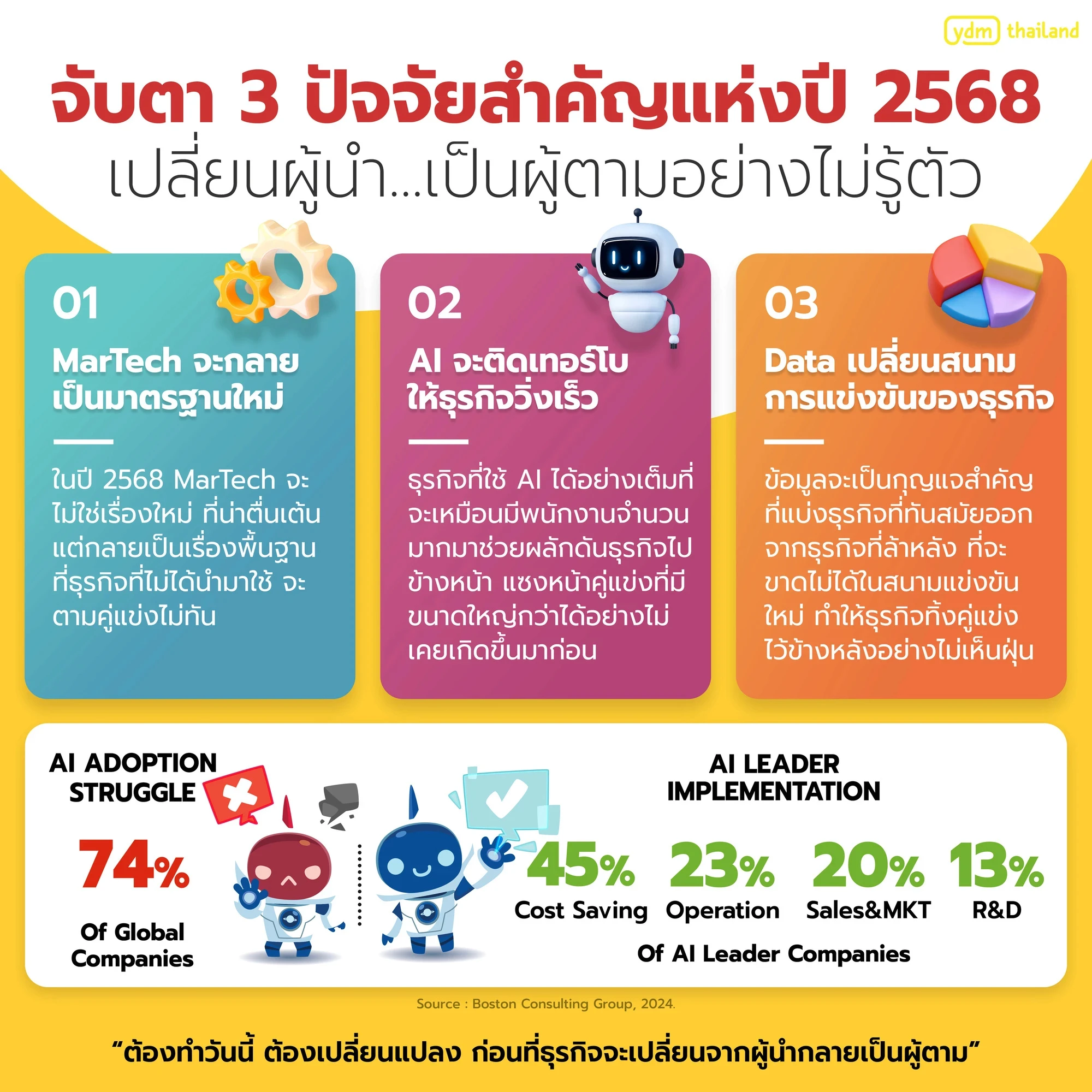
From these interconnections, it must be said that Alibaba is actually a data company.
Data is the bloodstream of the new economy
Alibaba is collecting massive amounts of data through shopping malls, e-wallets, entertainment content, social media, and more. It then analyzes this data in depth with advanced technology, enabling Alibaba to understand consumer behavior better than consumers understand themselves. This data can be used to improve products and services, create superior experiences for customers within its ecosystem, or even sell analyzed data to partners for enormous value.
Ant Finance, one of Alibaba Group’s companies, is the world’s largest fintech company, with a business value of US$75 billion.
One of Ant Finance’s services is personal lending, which is astonishing. Applicants simply request a loan through the website with no collateral documents. The system pulls data from Alibaba’s data warehouse—shopping behavior, selling behavior, interests, payment behavior, and more—calculates everything automatically, and within seconds tells the applicant how many yuan they can borrow!
As soon as the applicant agrees to the interest terms, the money is transferred into Alipay immediately!
Ask Thai banks how many days the entire process takes when someone applies for a loan. If Ant Finance were to launch in Thailand, could Thai banks compete?
In any case, the Thai government has now already joined hands with Jack Ma to cooperate on e-commerce.
But in other areas—especially data—I am not sure how our government is managing the issue.
I am very confident that Jack Ma is not looking only at Thailand’s e-commerce market. He is looking at something much bigger.
Small entrepreneurs like us can only sit and watch as a giant comes in to revolutionize our industry.
Let us keep fighting, all Thai entrepreneurs.
“Amid the winds of change, some build walls, while others build windmills!!”