
YDM has categorized Thai organizations in the digital marketing transformation world into four species. “Dinosaur,” representing 20%, is the least prepared group, still doing traditional marketing with mass communication. “Chimpanzee,” the largest group at 50%, has started using data but stores it separately rather than centrally, creating a risk of inaccurate decisions. “Sapiens,” at 25%, has come more than halfway through marketing transformation, sees data connections along the consumer journey, carries out personalized marketing, and has begun simple marketing automation such as CRM. “Homo Deus,” the advanced species that has successfully completed marketing transformation, accounts for only 5% of Thai organizations. YDM also provides guidance on how each type can accelerate its progress, emphasizing that data is a key tool for brands, alongside the effective use of MarTech tools and expert support, to drive measurable sales growth and strengthen competitiveness.
Tanapon Subsomboon, Chief Executive Officer of YDM (Thailand) Co., Ltd., said that while organizations around the world are moving forward with marketing transformation to keep up with changes in the digital environment and intense market competition, many factors affect the difficulty and time required for transformation, such as personnel readiness in both mindset and skill set, internal data management systems, the choice of MarTech tools, and investment in both budget and time. These factors create gaps between organizations that have successfully transformed, those in progress, and those just starting. Based on more than 10 years of experience working with clients across many industries, YDM has classified organizations into four species, along with recommendations for improving each organization for the new marketing world, so Thai organizations can better understand themselves and move forward in upgrading their marketing into the digital era:
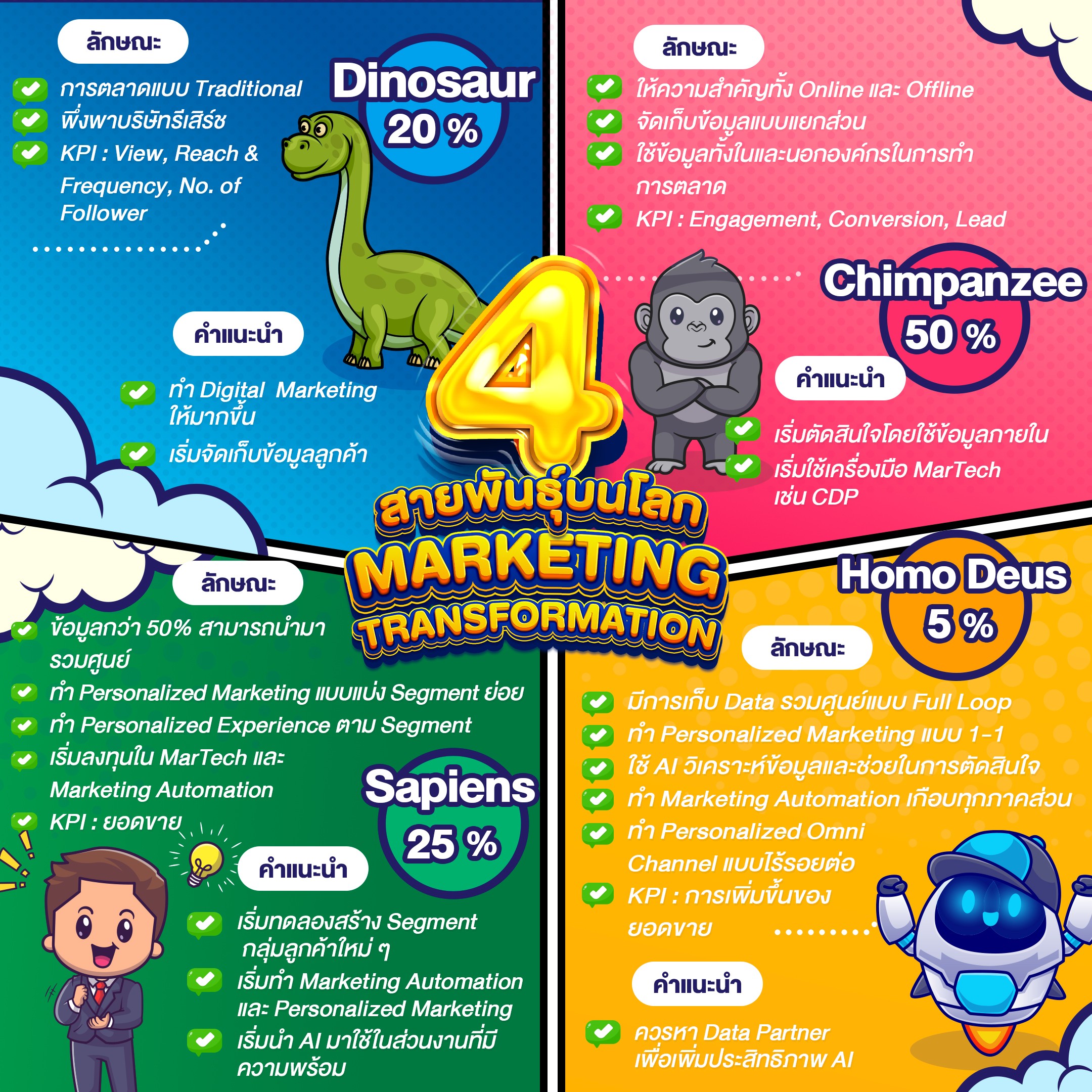
Group 1: Dinosaur, about 20%. This group is the least ready for transformation. They still do traditional marketing, focus on mass communication, define broad target groups by gender, age, generation, location, etc., do not create behavioral segmentation, and rely mainly on offline media. They use research-company sample data and determine marketing direction based on senior executives’ experience. Their working process is relatively slow, with campaigns taking 2–3 months, and campaign KPIs depend on media KPIs such as views, reach and frequency, and number of followers. YDM recommends that this group increase its use of digital marketing and collect as much data as possible on customers and potential customers at every touchpoint in order to move up to Group 2.
Group 2: Chimpanzee, found in around 50% of Thai organizations and the most common group. This group has started transforming and is more ready in terms of data and digital marketing. They use a mix of online and offline channels and give equal importance to both. They have begun managing data, but it is still stored separately rather than centrally. They start using data to guide marketing decisions, drawing on both internal and external data, but because the data is fragmented, decisions can be inaccurate. For example, a media agency may run digital advertising to generate leads for the sales team, but the agency does not receive feedback from sales on whether those leads converted into actual sales. The agency can only optimize for the lowest cost per lead, even though the cheapest leads may not be quality leads and may not convert at all.
For the Chimpanzee group, advertising KPIs are more multidimensional, such as engagement, conversion, or leads. YDM recommends that organizations in this group collect internal data in greater detail, try to centralize it in one place, and consider beginning to use MarTech tools such as a Customer Data Platform (CDP).
Group 3: Sapiens, found in 25% of organizations. This group has started using customer data and marketing technology to increase sales and has progressed more than halfway through marketing transformation. Marketing decisions are made mainly using internal data, and more than 50% of the data can be centralized. They are beginning to see data connections along the consumer journey, which enables personalized marketing through smaller behavioral segments and personalized customer experiences, with communications, product and service offerings, and promotions appropriately tailored to each segment. They begin investing in marketing technology such as CDP, chatbots, and data analytics tools, and start using marketing automation in less complex areas such as CRM, allowing the brand to understand customers better and communicate more effectively with target audiences.
For the Sapiens group, the KPI for advertising is “sales,” because they can clearly measure the impact of advertising on sales. YDM recommends that this group begin testing new customer segments from the data they already have to identify business expansion opportunities, develop multiple use cases for marketing automation and personalized marketing, and start applying AI in data functions that are ready.
The final and most advanced species is Homo Deus, found in only 5% of Thai organizations. This group has successfully transformed itself and uses marketing automation and AI in full. Data is collected at every touchpoint in the consumer journey, centralized in one place, and connected in a full loop. Everyone makes decisions based on the same dataset. Because of the completeness of the data, they can carry out individual-level personalized marketing—for example, with 50,000 customers, they can present offers tailored to each person’s needs. AI is used to analyze data and support decision-making, reducing the need for human decisions in many areas. Marketing automation is implemented across almost every part of the consumer journey. They have the ability to understand customers, communicate with the right message in the right place at the right time, and conduct seamless personalized omnichannel marketing, like Netflix, where users can continue watching anywhere, anytime, across all platforms, both online and offline.
For the Homo Deus group, the KPI is “increased sales,” which depends on progress in using marketing technology and in collecting data to feed AI. The more data is fed back to AI, the smarter the AI becomes, improving marketing efficiency at lower cost. For advanced organizations like Homo Deus, YDM recommends focusing on finding data partners, because the data an organization collects on its own may not be enough. Finding data partners across many industries can expand the size of the database, broaden the consumer base, and create new business opportunities.
“Data is a critical cog in marketing transformation, alongside the use of effective MarTech. YDM Thailand has used its experience and expertise to help accelerate the marketing transformation of many Thai organizations to success, opening up new business opportunities by combining expert teams with suitable MarTech platforms to help organizations manage data and implement customer data platforms (CDP) quickly and successfully.”
YDM has categorized Thai organizations in the digital marketing transformation world into four species. “Dinosaur,” representing 20%, is the least prepared group, still doing traditional marketing with mass communication. “Chimpanzee,” the largest group at 50%, has started using data but stores it separately rather than centrally, creating a risk of inaccurate decisions. “Sapiens,” at 25%, has come more than halfway through marketing transformation, sees data connections along the consumer journey, carries out personalized marketing, and has begun simple marketing automation such as CRM. “Homo Deus,” the advanced species that has successfully completed marketing transformation, accounts for only 5% of Thai organizations. YDM also provides guidance on how each type can accelerate its progress, emphasizing that data is a key tool for brands, alongside the effective use of MarTech tools and expert support, to drive measurable sales growth and strengthen competitiveness.
Tanapon Subsomboon, Chief Executive Officer of YDM (Thailand) Co., Ltd., said that while organizations around the world are moving forward with marketing transformation to keep up with changes in the digital environment and intense market competition, many factors affect the difficulty and time required for transformation, such as personnel readiness in both mindset and skill set, internal data management systems, the choice of MarTech tools, and investment in both budget and time. These factors create gaps between organizations that have successfully transformed, those in progress, and those just starting. Based on more than 10 years of experience working with clients across many industries, YDM has classified organizations into four species, along with recommendations for improving each organization for the new marketing world, so Thai organizations can better understand themselves and move forward in upgrading their marketing into the digital era:
Group 1: Dinosaur, about 20%. This group is the least ready for transformation. They still do traditional marketing, focus on mass communication, define broad target groups by gender, age, generation, location, etc., do not create behavioral segmentation, and rely mainly on offline media. They use research-company sample data and determine marketing direction based on senior executives’ experience. Their working process is relatively slow, with campaigns taking 2–3 months, and campaign KPIs depend on media KPIs such as views, reach and frequency, and number of followers. YDM recommends that this group increase its use of digital marketing and collect as much data as possible on customers and potential customers at every touchpoint in order to move up to Group 2.
Group 2: Chimpanzee, found in around 50% of Thai organizations and the most common group. This group has started transforming and is more ready in terms of data and digital marketing. They use a mix of online and offline channels and give equal importance to both. They have begun managing data, but it is still stored separately rather than centrally. They start using data to guide marketing decisions, drawing on both internal and external data, but because the data is fragmented, decisions can be inaccurate. For example, a media agency may run digital advertising to generate leads for the sales team, but the agency does not receive feedback from sales on whether those leads converted into actual sales. The agency can only optimize for the lowest cost per lead, even though the cheapest leads may not be quality leads and may not convert at all.
For the Chimpanzee group, advertising KPIs are more multidimensional, such as engagement, conversion, or leads. YDM recommends that organizations in this group collect internal data in greater detail, try to centralize it in one place, and consider beginning to use MarTech tools such as a Customer Data Platform (CDP).
Group 3: Sapiens, found in 25% of organizations. This group has started using customer data and marketing technology to increase sales and has progressed more than halfway through marketing transformation. Marketing decisions are made mainly using internal data, and more than 50% of the data can be centralized. They are beginning to see data connections along the consumer journey, which enables personalized marketing through smaller behavioral segments and personalized customer experiences, with communications, product and service offerings, and promotions appropriately tailored to each segment. They begin investing in marketing technology such as CDP, chatbots, and data analytics tools, and start using marketing automation in less complex areas such as CRM, allowing the brand to understand customers better and communicate more effectively with target audiences.
For the Sapiens group, the KPI for advertising is “sales,” because they can clearly measure the impact of advertising on sales. YDM recommends that this group begin testing new customer segments from the data they already have to identify business expansion opportunities, develop multiple use cases for marketing automation and personalized marketing, and start applying AI in data functions that are ready.
The final and most advanced species is Homo Deus, found in only 5% of Thai organizations. This group has successfully transformed itself and uses marketing automation and AI in full. Data is collected at every touchpoint in the consumer journey, centralized in one place, and connected in a full loop. Everyone makes decisions based on the same dataset. Because of the completeness of the data, they can carry out individual-level personalized marketing—for example, with 50,000 customers, they can present offers tailored to each person’s needs. AI is used to analyze data and support decision-making, reducing the need for human decisions in many areas. Marketing automation is implemented across almost every part of the consumer journey. They have the ability to understand customers, communicate with the right message in the right place at the right time, and conduct seamless personalized omnichannel marketing, like Netflix, where users can continue watching anywhere, anytime, across all platforms, both online and offline.
For the Homo Deus group, the KPI is “increased sales,” which depends on progress in using marketing technology and in collecting data to feed AI. The more data is fed back to AI, the smarter the AI becomes, improving marketing efficiency at lower cost. For advanced organizations like Homo Deus, YDM recommends focusing on finding data partners, because the data an organization collects on its own may not be enough. Finding data partners across many industries can expand the size of the database, broaden the consumer base, and create new business opportunities.
“Data is a critical cog in marketing transformation, alongside the use of effective MarTech. YDM Thailand has used its experience and expertise to help accelerate the marketing transformation of many Thai organizations to success, opening up new business opportunities by combining expert teams with suitable MarTech platforms to help organizations manage data and implement customer data platforms (CDP) quickly and successfully.”
YDM has categorized Thai organizations in the digital marketing transformation world into four species. “Dinosaur,” representing 20%, is the least prepared group, still doing traditional marketing with mass communication. “Chimpanzee,” the largest group at 50%, has started using data but stores it separately rather than centrally, creating a risk of inaccurate decisions. “Sapiens,” at 25%, has come more than halfway through marketing transformation, sees data connections along the consumer journey, carries out personalized marketing, and has begun simple marketing automation such as CRM. “Homo Deus,” the advanced species that has successfully completed marketing transformation, accounts for only 5% of Thai organizations. YDM also provides guidance on how each type can accelerate its progress, emphasizing that data is a key tool for brands, alongside the effective use of MarTech tools and expert support, to drive measurable sales growth and strengthen competitiveness.
Tanapon Subsomboon, Chief Executive Officer of YDM (Thailand) Co., Ltd., said that while organizations around the world are moving forward with marketing transformation to keep up with changes in the digital environment and intense market competition, many factors affect the difficulty and time required for transformation, such as personnel readiness in both mindset and skill set, internal data management systems, the choice of MarTech tools, and investment in both budget and time. These factors create gaps between organizations that have successfully transformed, those in progress, and those just starting. Based on more than 10 years of experience working with clients across many industries, YDM has classified organizations into four species, along with recommendations for improving each organization for the new marketing world, so Thai organizations can better understand themselves and move forward in upgrading their marketing into the digital era:
Group 1: Dinosaur, about 20%. This group is the least ready for transformation. They still do traditional marketing, focus on mass communication, define broad target groups by gender, age, generation, location, etc., do not create behavioral segmentation, and rely mainly on offline media. They use research-company sample data and determine marketing direction based on senior executives’ experience. Their working process is relatively slow, with campaigns taking 2–3 months, and campaign KPIs depend on media KPIs such as views, reach and frequency, and number of followers. YDM recommends that this group increase its use of digital marketing and collect as much data as possible on customers and potential customers at every touchpoint in order to move up to Group 2.
Group 2: Chimpanzee, found in around 50% of Thai organizations and the most common group. This group has started transforming and is more ready in terms of data and digital marketing. They use a mix of online and offline channels and give equal importance to both. They have begun managing data, but it is still stored separately rather than centrally. They start using data to guide marketing decisions, drawing on both internal and external data, but because the data is fragmented, decisions can be inaccurate. For example, a media agency may run digital advertising to generate leads for the sales team, but the agency does not receive feedback from sales on whether those leads converted into actual sales. The agency can only optimize for the lowest cost per lead, even though the cheapest leads may not be quality leads and may not convert at all.
For the Chimpanzee group, advertising KPIs are more multidimensional, such as engagement, conversion, or leads. YDM recommends that organizations in this group collect internal data in greater detail, try to centralize it in one place, and consider beginning to use MarTech tools such as a Customer Data Platform (CDP).
Group 3: Sapiens, found in 25% of organizations. This group has started using customer data and marketing technology to increase sales and has progressed more than halfway through marketing transformation. Marketing decisions are made mainly using internal data, and more than 50% of the data can be centralized. They are beginning to see data connections along the consumer journey, which enables personalized marketing through smaller behavioral segments and personalized customer experiences, with communications, product and service offerings, and promotions appropriately tailored to each segment. They begin investing in marketing technology such as CDP, chatbots, and data analytics tools, and start using marketing automation in less complex areas such as CRM, allowing the brand to understand customers better and communicate more effectively with target audiences.
For the Sapiens group, the KPI for advertising is “sales,” because they can clearly measure the impact of advertising on sales. YDM recommends that this group begin testing new customer segments from the data they already have to identify business expansion opportunities, develop multiple use cases for marketing automation and personalized marketing, and start applying AI in data functions that are ready.
The final and most advanced species is Homo Deus, found in only 5% of Thai organizations. This group has successfully transformed itself and uses marketing automation and AI in full. Data is collected at every touchpoint in the consumer journey, centralized in one place, and connected in a full loop. Everyone makes decisions based on the same dataset. Because of the completeness of the data, they can carry out individual-level personalized marketing—for example, with 50,000 customers, they can present offers tailored to each person’s needs. AI is used to analyze data and support decision-making, reducing the need for human decisions in many areas. Marketing automation is implemented across almost every part of the consumer journey. They have the ability to understand customers, communicate with the right message in the right place at the right time, and conduct seamless personalized omnichannel marketing, like Netflix, where users can continue watching anywhere, anytime, across all platforms, both online and offline.
For the Homo Deus group, the KPI is “increased sales,” which depends on progress in using marketing technology and in collecting data to feed AI. The more data is fed back to AI, the smarter the AI becomes, improving marketing efficiency at lower cost. For advanced organizations like Homo Deus, YDM recommends focusing on finding data partners, because the data an organization collects on its own may not be enough. Finding data partners across many industries can expand the size of the database, broaden the consumer base, and create new business opportunities.
“Data is a critical cog in marketing transformation, alongside the use of effective MarTech. YDM Thailand has used its experience and expertise to help accelerate the marketing transformation of many Thai organizations to success, opening up new business opportunities by combining expert teams with suitable MarTech platforms to help organizations manage data and implement customer data platforms (CDP) quickly and successfully.”
[
Connect
]
How can we help you innovate?
Drop us a line.
Get in
touch
[
Connect
]
How can we help you innovate?
Drop us a line.
Get in
touch
[
Connect
]
How can we help you innovate?
Drop us a line.
Get in
touch
Related
Movements.

{
News
}
Unlocking the Secret: 8 Keys to Creating Impactful Advertising Campaigns
Jan 15, 2025
{
News
}
Unlocking the Secret: 8 Keys to Creating Impactful Advertising Campaigns
Jan 15, 2025

{
News
}
YDM Makes Waves with Double Wins at Meta Awards, Reveals Key Drivers Behind Its Success
Dec 24, 2024
{
News
}
YDM Makes Waves with Double Wins at Meta Awards, Reveals Key Drivers Behind Its Success
Dec 24, 2024
{
News
}
YDM Transforms the BI Landscape with Looker: Making Data “Simple” and More Effective (Looker is not Looker Studio)
Dec 17, 2024
{
News
}
YDM Transforms the BI Landscape with Looker: Making Data “Simple” and More Effective (Looker is not Looker Studio)
Dec 17, 2024
{
News
}
Unlocking the Secret: 8 Keys to Creating Impactful Advertising Campaigns
Jan 15, 2025
{
News
}
YDM Makes Waves with Double Wins at Meta Awards, Reveals Key Drivers Behind Its Success
Dec 24, 2024
{
News
}
YDM Transforms the BI Landscape with Looker: Making Data “Simple” and More Effective (Looker is not Looker Studio)
Dec 17, 2024
{
News
}
Watch Out: 3 Key Factors in 2025 That Could Turn Leaders into Followers Without Realizing It
Dec 3, 2024
{
News
}
Unlocking the Secret: 8 Keys to Creating Impactful Advertising Campaigns
Jan 15, 2025
{
News
}
YDM Makes Waves with Double Wins at Meta Awards, Reveals Key Drivers Behind Its Success
Dec 24, 2024
{
News
}
YDM Transforms the BI Landscape with Looker: Making Data “Simple” and More Effective (Looker is not Looker Studio)
Dec 17, 2024
{
News
}
Watch Out: 3 Key Factors in 2025 That Could Turn Leaders into Followers Without Realizing It
Dec 3, 2024